
Hack My Teacher
Hack My Teacher makes the system visible. Explore a practical tool for the problem in front of you, or build a broader set of academic habits through The Academic Reset.
Check out some of our FREE RESOURCES
Five free one-page guides to help students handle everyday academic situations with greater clarity and confidence. This set covers submitting assignments, understanding teacher feedback, recovering after missed school, interpreting directions, and asking for help when an assignment is unclear.
Five free one-page guides to help students turn mistakes, feedback, and incomplete answers into better academic work. This set covers recovering from a bad grade, starting homework with clarity, asking teachers for useful help, understanding what teachers notice, and turning studying into meaningful preparation.
Five free one-page guides for students who want to prepare more effectively for tests and produce stronger academic answers. This set explains the difference between studying and rereading, how to prepare the night before a test, how to use evidence, how to read test questions carefully, and how to strengthen written responses.
Five free one-page guides for students who want to use feedback more effectively and produce more complete, well-supported work. This set explains how to learn from returned assignments, respond to criticism, recognize why answers lose credit, prioritize missing work, and use examples without copying.
Free Guide!!!
50 Ways to Hack Your Teacher in ‘26-’27
Learn what teachers know that students don't.

Start Your Journey Free
The Academic Reset Foundations
Get a practical introduction to the signals teachers send, the questions students can ask, and the habits that make schoolwork more manageable. Use it to recognize one change your student can try this week.

These focused resources help with one immediate academic challenge. If the same problem keeps appearing across classes or weeks, The Academic Reset offers the broader system.
Choose a tool for the problem in front of you
Make School Easier Before You Study Harder
A practical guide to becoming easier to help, more organized, and more confident at school—before you change how you study.
Many academic problems begin before studying: unclear directions, missed deadlines, vague questions, unused feedback, and uncertainty about what to do next.
This 16-page student toolkit teaches students how to manage those moments more effectively. It helps them communicate with teachers, track their responsibilities, recover from setbacks, and make their effort visible.
Students learn how to:
Start class prepared and identify the first step
Record assignments, deadlines, and next actions
Ask focused questions that teachers can answer
Communicate before a deadline becomes a crisis
Write effective messages after an absence or missed deadline
Turn teacher feedback into a specific revision
Participate more effectively in class and group work
Recover when work is missing or several deadlines compete
Build a seven-school-day improvement routine
Use printable daily, weekly, and help-request worksheets
The toolkit includes subject-specific examples for mathematics, reading, writing, science, and history, along with ready-to-use scripts students can adapt to their own voice.
This is not about pretending to be a different kind of student or trying to earn special treatment. It is about learning the habits that make school interactions clearer, reduce avoidable stress, and help students take greater responsibility for their own progress.
Includes
16-page digital PDF toolkit
Quick-start guide
Student self-audit
Classroom readiness routine
Assignment-tracking system
Help-request formula
Teacher communication templates
Feedback and revision routine
Group-work strategies
Missed-work recovery plan
Seven-day starter plan
Printable daily launch sheet
Weekly assignment dashboard
Help-request and reflection worksheet

A better plan for the test that is coming next
Your student has a test coming up. They may be rereading notes, watching review videos, or spending a long time studying without knowing whether the work is helping.
Study Smarter Before the Next Test gives them a clear process for preparing: identify what the assessment actually asks, test what they can produce without notes, correct the weak points, and return to those targets before test day.
It is a practical guide for one real assessment. Students can use it with history, English, science, math, economics, and most other academic subjects.What the guide helps your student do
1. Find the real targets
Students learn to read the teacher’s review guide, learning goals, assignments, rubrics, examples, and repeated class work for useful signals. They identify both the content and the action the test may require: define, compare, explain, solve, interpret, or support a claim.
2. Check readiness with evidence
The guide moves students from “I looked at it” to “I tried it without help.” They attempt representative questions, compare their work with a reliable source, and sort each target into a practical starting category.
3. Build better practice
Students learn how to turn definitions into questions, worked examples into fresh problems, diagrams into reconstruction tasks, rubrics into response checklists, and teacher corrections into new practice prompts.
4. Correct the actual error
The guide helps students distinguish a knowledge gap from a procedure mistake, a missed prompt requirement, a weak explanation, or a timing problem. Each type of error calls for a different next move.
5. Plan across the time available
Students receive routes for a test seven days away, three days away, or tomorrow. Each route uses the same practical cycle: attempt, check, correct, retry, and revisit.
6. Learn from the returned test
After the assessment, students compare predicted readiness with actual performance. They can see whether they practiced the wrong skill, missed a prompt demand, needed more fluency, or failed to transfer an idea to unfamiliar wording.
What is included
A 30-minute launch sequence that creates the first usable study plan.
An assessment map for test date, format, topics, response types, materials, and uncertainty.
A teacher-signal guide that helps students identify likely skills without pretending to predict exact questions.
A target list and readiness diagnostic.
A question-building method for notes, examples, diagrams, rubrics, and teacher feedback.
A complete attempt–check–correct–retry–revisit study loop.
Subject-specific practice routes for facts, concepts, math, quantitative science, processes, diagrams, essays, short answers, and source analysis.
An error diagnosis guide and reusable error log.
Seven-day, three-day, and tomorrow study plans.
A reusable study schedule and mini-mock assessment.
A deliberate test-day routine.
A post-test review that turns the result into a better next plan.
Parent prompts that support the student without taking over the work.
A one-test action sheet for immediate use.
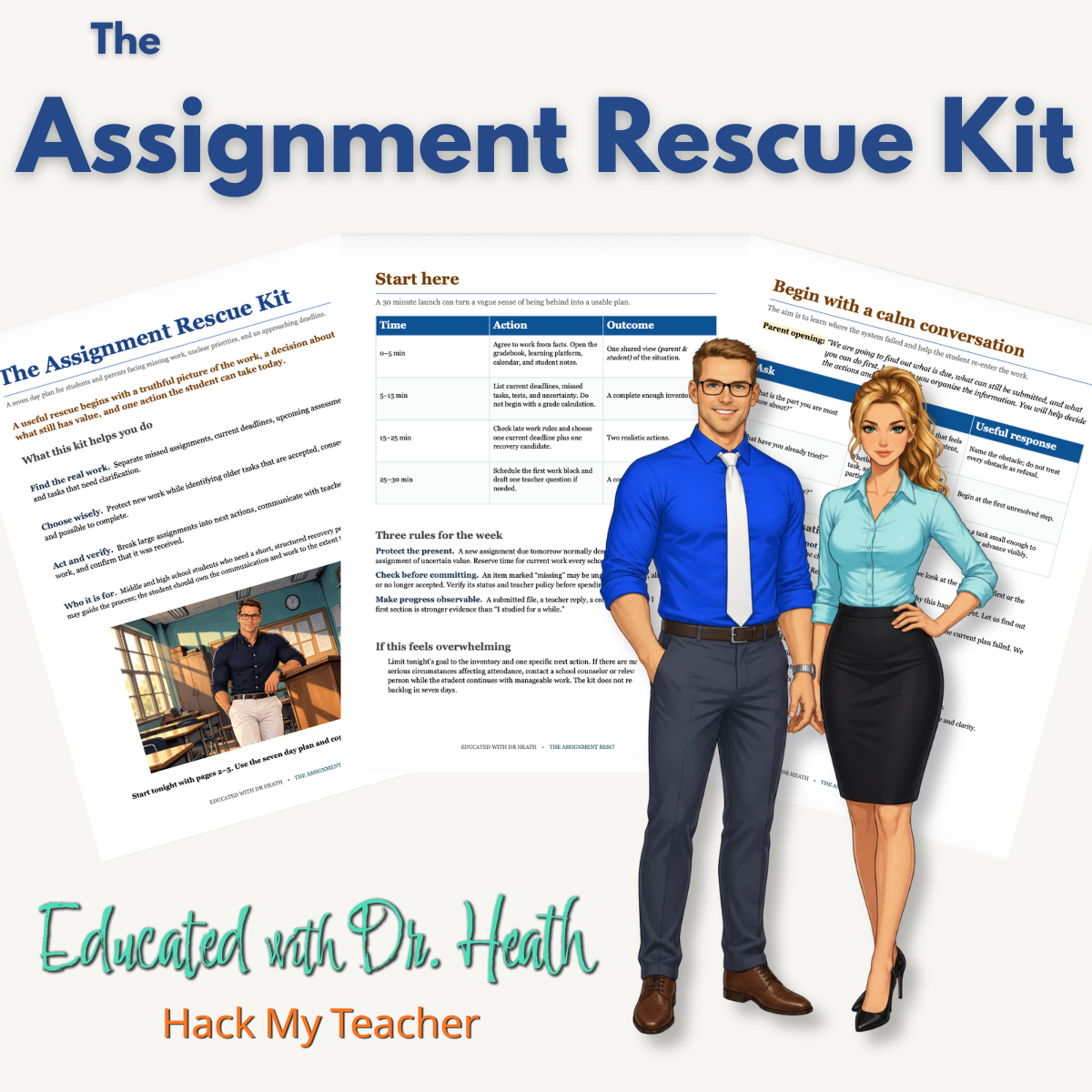
A clear plan for the week your student has fallen behind
The gradebook shows missing work. A deadline is approaching. Your student feels overwhelmed, and nobody is sure which assignment should come first.
The Assignment Rescue Kit helps students and parents turn that uncertainty into a workable seven-day plan. It shows you how to identify what is actually missing, verify what the teacher will still accept, protect current deadlines, choose the best recovery tasks, communicate clearly, and begin with one visible next action.
1. Create one accurate picture
The assignment inventory brings together the gradebook, learning platform, calendar, class directions, tests, and student notes. It separates current work, late work, unclear items, possible submission errors, and work that has been closed.
2. Choose priorities using facts
Students learn to protect present deadlines before spending all their energy on old work. They consider acceptance, academic value, urgency, dependencies, and the time required before deciding what to do next.
3. Contact teachers with a useful question
The kit includes adaptable messages for late-work acceptance, unclear directions, and a submission that appears to be missing. The student can write in their own voice while asking one precise question at a time.
4. Make a large task startable
“Do the project” becomes a sequence of visible steps: open the prompt, identify the required parts, locate a model or source, complete the first section, compare the work with the criteria, submit, and verify receipt.
5. Run a realistic seven-day recovery plan
The plan keeps current work moving while assigning focused blocks to the older work that is still accepted and worth completing. It adjusts when a teacher replies, a deadline changes, or the original plan proves too large.
6. Build a maintenance routine
The final pages help the student check new assignments, record teacher responses, schedule the next action, and prevent one rescued week from becoming another backlog.
What is included
A 30-minute launch sequence for the first evening.
A calm parent/student conversation guide.
A complete assignment inventory across classes.
Status labels for current, late, ask, verify, and closed work.
A recovery decision guide for acceptance, value, urgency, dependency, and cost.
A priority worksheet that protects the current track and identifies the first recovery action.
Three teacher communication templates.
A teacher reply log and next-action guide.
A large-assignment breakdown method with a completed history example.
Work-block guidance for starting, continuing, submitting, and adjusting tasks.
A seven-day recovery plan.
A weekly planning sheet with alternate times for interruptions.
A daily work record and submission verification checklist.
Guidance for difficult situations, including unclear policy, conflicting deadlines, and a student who cannot begin.
A bridge to The Academic Reset when the issue extends beyond one week of missing work.

14 Day Satisfaction Guarantee
We want you to feel confident in your investment. Our goal is to provide practical, research-based strategies that help students become more independent, organized, and successful learners.
Our instructors



-
Founder
The creative leader of the project. An alum of UCLA’s top-ranked school of education, Dr. Heath is straightforward, thoughtful, and excellent at breaking down subjects and techniques. He is the go-to for how best to break your teacher’s secret code.
-
Virtual Assistant
Phoebe is great! As Dr. Heath’s sidekick, she’ll give you all the best tips and tricks, as well as a little background on whatever topics you may be tackling.
-
Our Adorable Mascot
Winston the Bulldog helps keep things in perspective. His words of wisdom hit deeper than they may appear at first. Keep an eye out for his bits of pure gold.
What Does “Hack My Teacher” Mean?
“Hack My Teacher” is not about manipulating teachers, gaming the system, or finding shortcuts around learning. It is about understanding how school actually works.
Teachers constantly communicate what matters through feedback, expectations, repeated ideas, grading criteria, questions, and even the way they respond to student effort. Most students encounter these signals every day without learning how to interpret them.
The “hack” is learning to recognize those patterns and respond strategically.
That means asking better questions, using feedback instead of ignoring it, understanding what assignments are really asking, studying in ways that produce learning rather than simply consume time, and developing habits that make success more reliable.
In that sense, Hack My Teacher is really about learning how to become a more effective student.
You are not hacking the teacher.
You are learning how to understand the system well enough to make it work for you.


